Friday, March 29, 2013

Coal Camp

New River Coalfield
 
The New River Coalfield is located in Raleigh County, WV and Fayette County, WV. The camp produced large amounts of bituminous coal. The coal company recruited white people who had recently immigrated to the States and African Americans from the South to work in the coal mine. The owners were Anderson and Thomas Orwell. They were brothers who went into business together and lost everything when the coal mine business fell through. It had a population of 5,000.  After 1945, the mine started to close.The Mine is now apart of the National Park Service . The NPS preserves the coal heritage in the area. 
 

Friday, March 15, 2013

Surface Mining

Strip Mining- Used when coal is near the surface or overburden is unstable. Mining progresses and overburden is placed in the previous mine cavity.
Advantages: faster, less worker death, cheaper
Disadvantages: destroys the landscape, pollution


Contour Mining- strip or surface mining follows the contour of the hill or mountain leaving terraces in the mountain side.
Advantages: Easier to get to the coal, less worker fatalities
Disadvantages: The contour of the land is never restored


Mountain Top Mining- Tops of hills are removed to access horizontal cal seams. Over burdeb is pushed to high elevations. following reclamation, the original contour is not restored. Most controversial mining method.
Advantages: safer for miners
Disadvantages: foundations of homes are damaged from the blasts, deforestation and water pollution


http://iml.jou.ufl.edu/projects/spring07/Bartlett/effects.html

Underground Mining

Drift Mining- Where coal seams intersect the surface; mine enters seam in a horizontal direction
Advantages: cheap and easy
Disadvantages- tunnels collapse


Shaft Mining- common method of accessing coal with elevators, deeper than 1000 feat below the surface
advantages: ventilation is okay, cheap
disadvantages: drilling the holes and charging them poses a huge risk
Shaft mine


Room and Pillar Mining- half of coal left behind to support roof, Disadvantage: pillars put pressure on adjacent pillars leading to roof collapse. Roof falls are a constant danger.
advantages: high degree of flexibility, process is repititous.
disadvantages: cost of maintenance is very high


Continuous Mining- Machines usedwith drift mining or pillar mining, one miner operates the machine, varieties of machines used since 1940's. Paired with conveyor systems to transport coal out of the mine.
advantages: constant flow of caol out of mine, uses less workers.
disadvantages: sometimes the machines arent alway productive, then one loses money to pay for the machines to run without results

Long Wall Mining- highly effecient, huge machines support roof with hydraulics and once the coal os removed, the machine retreats and roof caves in.
advantages: can gather a lot more coal
disadvantages: more dust is generated at a dangerous rate
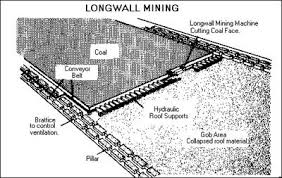


http://library.thinkquest.org/05aug/00461/shaft.htm

How Coal is Formed

     Coal formed in during the Pennsylvannian Period. Dead plant remains in swamp areas form peat. When the sun's light hits the plants it excites the electrons in chlorophyll. The high energy creates ATP and electron carriers. The ATP and electron carroers form bonds with CO2 to make carbohydrates.  After this the peat is pressurized and compacted over many years.

Wednesday, January 30, 2013

Aerosols Effect on Climate Change

I predict that aerosols will impact climate change in a couple ways. The aerosol particles that are the same size as the sun's energy waves will reflect the suns energy back into the atmosphere. This will reduce the amount of energy that enters earth's atmosphere and become absorbed by the earth's surface. However that does not mean that all of the sun's energy will be reflected.

 Most of the energy will enter the earth's atmosphere and be either reflected by a light surface or absorbed by a dark surface. In urbanized areas of the world, the energy is absorbed and re-emitted as long wave infrared radiation. This causes the urban areas to be much hotter. This radiation, is trapped on earth by aerosols. The more aerosols in the air, the more cloud coverage. According to Aerosols and Climate Change by Mary Hardin and Ralph Kahn, the clouds will trap the radiation on earth causing there to be a hotter climate. A hotter climate means that more moisture is evaporating and being soaked up by the clouds. This causes more rain fall but in various places. To add to the rain fall, the ice caps will melt and the sea levels will rise. 

Wednesday, November 7, 2012

Summary of Notes

The atmosphere is made up of a variety of gases. Some of which are contributors to the greenhouse effect. These factors are water vapor and carbon dioxide. Because of fossil fuels, carbon dioxide levels have risen 18% since 1958. To better understand the greenhouse effect and the things that contribute to this issue we also have to understand air pressure. Vertical air pressure decreases with height. So the farther you travel into outer space the less vertical air pressure there is to impact you.
Solar radiation involves two concepts, Albedo and Absorption. Albedo is the energy that is reflected back into space. Absorption is not reflected but re-emits the energy as long wave infrared radiation. This is important because this is a major component in the Urban Heat Island Effect. This means where ever there is a city or an urban area, the re-emitted energy is higher there, thus the temperature is higher.  Relative Humidity is the amount of water that the air can hold. Humidity is the water vapor stuck between air molecules.